



Personalized Brain & Body Health
Feel stronger. Think clearer. Live with confidence.
Lifestyle changes, medications, supplements, and our health-care system can be confusing—especially if you’re noticing memory changes.
You don’t have to do it alone.
Together, we’ll make healthy living doable—and sustainable—for you.
I’m Janine Garcia, Board-Certified Ambulatory Care Pharmacist, ReCODE 2.0 Certified Practitioner, MoCA-certified, and trained in aging and cognitive health. With 15+ years of experience supporting endocrine, heart, lung, and mental-health conditions, I help older adults strengthen brain function, improve daily resilience, and rely less on unnecessary medications and supplements.
After seeing the profound impact of dementia on patients and families, I trained in the Bredesen Protocol to offer practical, personalized care to those concerned about memory loss. My approach blends the best of conventional and functional medicine—always delivered with the same compassion I’d offer my own parents.
Dementia is life-changing, but with the right support, you can reduce stress, remove obstacles, and improve quality of life with a plan that feels doable, empowering, and aligned with your values.
Whether you prefer 1:1 guidance, a small supportive group, or simple tools to streamline your wellness routine, you’ll gain clear steps, steady encouragement, and a community that celebrates progress—not perfection.
Schedule a free, no-pressure 20-minute call to explore your goals and find the support that fits you best.

The Cognition Crusade
Brain health challenges can be isolating, but you don’t have to face them alone. At Functional Pharmacy, we created the Cognition Crusaders to offer a supportive, evidence-based space for patients, caregivers, and individuals looking to strengthen memory, focus, and everyday cognitive resilience. Together, we explore practical tools and build habits that make protecting your brain both achievable and sustainable.
What's included:
-
Weekly 60–90 min session (educational + interactive)
-
Handouts: food plans, checklists, lab interpretation guides
-
Optional “lab bundle” participants can order before/after the course
-
A fun community support group

Week 1: Planning your days and creating structure
Key Concepts: How routine makes things easier for both patients and caregivers, oral health, science behind basic lifestyle interventions
Practical Takeaway: Build your ideal morning and evening routine
Week 2: Managing medications and supplements
Key Concepts: Options and reseach for someone with dementia, how to simplify medications and supplements
Practical Takeaway: Streamline your medicaton calendar and reduce pill burden
Week 3: Getting the most from visits with a provider
Key Concepts: Understanding your labs, how to priotize your focus, and what are good questions to ask
Practical Takeaway: Have a clear health plan and list of questions ready to ask your provider at your next visit
Week 4: Loving communication
Key Concepts: How to speak to someone with dementia and maintain a postive attitude
Practical Takeaway: Learn to correctly shift your perspective when having a conversation with someone with dementia
Week 5: Sleep as Medicine
Key Concepts: Sleep architecture, circadian rhythm, glymphatic clearance
Labs/Markers: Optional: sleep study, wearable tracker metrics
Practical Takeaway: Build a sleep hygiene plan: wind-down ritual, blue-light cutoff, cool/dark room
Week 6: Stress & Resilience
Key Concepts: Cortisol rhythm, burnout risk, resilience practices (HRV, breathwork, meditation)
Practical Takeaway: Begin a daily 5-minute resilience ritual (breathwork, mindfulness, journaling)
Week 7: Movement for Longevity
Key Concepts: Exercise as medicine, strength for sarcopenia prevention, Zone 2 cardio
Practical Takeaway: Create a weekly routine: 2 strength, 2 cardio, 1 flexibility/recovery session
Week 8: Hormonal Balance
Key Concepts: Sex hormones, thyroid, insulin resistance, hormone shifts in men & women
Labs/Markers: TSH, free T3/T4, testosterone, estradiol, progesterone, insulin
Practical Takeaway: Learn your hormone “signals” (sleep changes, energy, weight distribution) and support balance through sleep + nutrition
Week 9: Brain Health & Cognitive Vitality
Key Concepts: Neuroplasticity, brain foods (omega-3s, polyphenols, BDNF-boosting activities)
Labs/Markers: B12, folate, ApoE genotype (optional), fasting insulin
Practical Takeaway: Add one new brain-boosting habit (puzzle, language learning, daily walk in nature)
Week 10: Detoxification & Environmental Health
Key Concepts: Creating a healting environment, reducing toxin exposure
Labs/Markers: GGT, optional heavy metals panel
Practical Takeaway: Audit home & personal care products → replace 1 item with low-toxin alternative
Week 11: Cardiometabolic Health
Key Concepts: Metabolic flexibility, blood sugar control, vascular health
Labs/Markers: Lipid panel, ApoB, HbA1c, fasting insulin, hs-CRP
Practical Takeaway: Try a 12-hour overnight fast + build balanced meals with protein & fiber
Week 12: Social Connection & Purpose
Key Concepts: Longevity, oxytocin, stress buffering through community
Labs/Markers: (Indirect: HRV improvement, reduced CRP with strong social ties)
Practical Takeaway: Intentionally schedule one meaningful social interaction
Week 13: Pulling it all together
Key Concepts: Integration, habit stacking, prioritization of “keystone” habits, brain-healthy diet through the holidays
Labs/Markers: Compare baseline vs. progress (labs, trackers, symptom inventory)
Practical Takeaway: Draft a 3-pillar personalized health blueprint (nutrition, movement, resilience)
Week 14: Long-Term Maintenance & Next Steps
Key Concepts: Health as a lifelong practice, accountability systems, caring for the caregiver
Labs/Markers: Decide on annual/biannual labs for prevention
Practical Takeaway: Commit to 90-day plan + peer accountability partner
WHAT WE CAN DO TOGETHER
Your Personalized Proactive Plan
- Clarify and set your health goals and priorities
- Understand your PreCODE/ReCODE Report
- Set up daily, weekly, and monthly routines
- Monitor and journal glucose and ketone levels
- Track progress with repeat cognitive assessments (including MoCA)

Medication & Supplement Management
- Simplify your medication/supplement list
- Create an easy-to-follow schedule
- Minimize side effects and check for interactions
- Understand benefits vs. risks and lab results
- Get plain-English explanations of research and provider recommendations
- Find cost-effective options

Nutrition Support
- Calculate your personal macronutrient targets
- Receive weekly meal plans with shopping lists
- Get help with pantry clean-outs and ingredient swaps
- Virtual or in-person meetups around cooking, grocery tours, or meal prep

Movement Made Manageable
-
Build aerobic fitness, balance, and strength safely into your day
-
“Walk & Talk” challenges where participants track steps and share photos or reflections
-
Help tracking your progress and setting new goals
-
Buddy pairings so participants have a “wellness partner” for accountability between sessions
Reducing Toxins
- Switch to nontoxic personal and home products
- Learn safer cookware and cooking techniques
- Home mold testing and gentle detox support

Brain & Stress Resilience
- Brain-stimulation strategies and memory exercises
- Stress management and better sleep habits
- Continuous nighttime oxygen monitoring
-
Mini-workshops on effective communication, boundary setting, and stress-reducing social skills
-
Guided exercises on expanding your social network, volunteering, or rekindling friendships
care partner support
- Practical tips for loving communication and redirection
- Small-group meet-ups for shared learning and encouragement
- Book club focused on positive caregiving
Special Bundled Packages
Essential Wellness
-
One-on-One Coaching [1 x 90 min + 4 sessions (60 min)]
-
Health Goal Planner (3 months)
-
Email Support
-
Investment $600
Complete Reset
-
One-on-One Coaching [8 sessions (1 x 90 min + 7 x 60 min)]
-
Health Goal Planner (6 months)
-
Small Group Meetups (8 sessions)
-
Seasonal Menu Planning (3 months)
-
Email Support
-
Investment $1,295
VIP Transformation
-
One-on-One Coaching [15 sessions (1 x 90 min + 14 x 60 min)]
-
Health Goal Planner (12 months)
-
Small Group Meetups (unlimited access)
-
Seasonal Menu Planning (full year)
-
Email Support + Priority Text Support
-
Priority Scheduling
-
Investment $2,995

SERVICES
One-on-One Coaching
Personalized support tailored to your unique health journey.
-
Hourly Session (60 minutes): $100
-
Perfect for focused guidance on a specific concern.
-
-
Starter Package – 5 Sessions: $600
-
Includes an initial 90-minute deep-dive and four 60-minute follow-ups.
-
A structured path to kickstart your transformation.
-
-
Continued Care Package – 5 Sessions: $400
-
For ongoing accountability and growth.
-
Five 60-minute sessions to keep you on track and progressing.
-
Small Group Coaching
Find community, accountability, and inspiration while working toward your goals together.
-
8 Group Meet-Ups (60–90 minutes each): $80
-
12 Group Meet-Ups (60–90 minutes each): $100
Medication & Supplement Review
- Complex Medication Review + Digital Schedule: $50
- Wallet Medication List (digital): $10 (add-on)
Nutrition & Lifestyle Tools
Extra resources to make healthy living simpler.
-
Seasonal Meal Planning in Cronometer: $750 per season, or $2,500 for a year
-
Personalized to your nutrition targets, with recipes & shopping lists
-
-
Personalized Health Goal Planner: $195/year
-
A practical daily, weekly, and monthly checklist system designed to keep you consistent.
-
Questions You May Be Wondering
Functional medicine is a personalized, systems-based approach to healthcare that focuses on identifying and addressing the root causes of disease. It’s grounded in the principles of systems biology, which means it views the body as an interconnected web of systems that influence one another dynamically. This approach emphasizes the biochemical individuality of each person, taking into account their unique genetic, environmental, and lifestyle factors to create tailored interventions aimed at restoring balance and optimizing health. It prioritizes a collaborative relationship between the patient and practitioner, focusing on the patient’s life story, lifestyle, and goals.
This contrasts with the more standardized, protocol-driven approach often seen in conventional medicine, which typically operates within a disease-centered model, focusing on diagnosing and treating specific diseases or symptoms, often using pharmaceuticals or surgical interventions. It’s highly effective for acute conditions, emergencies, and infections, where targeted treatments can save lives. However, it often falls short when addressing chronic, complex conditions like diabetes, autoimmune diseases, or cardiovascular issues, which are influenced by a multitude of factors over time.
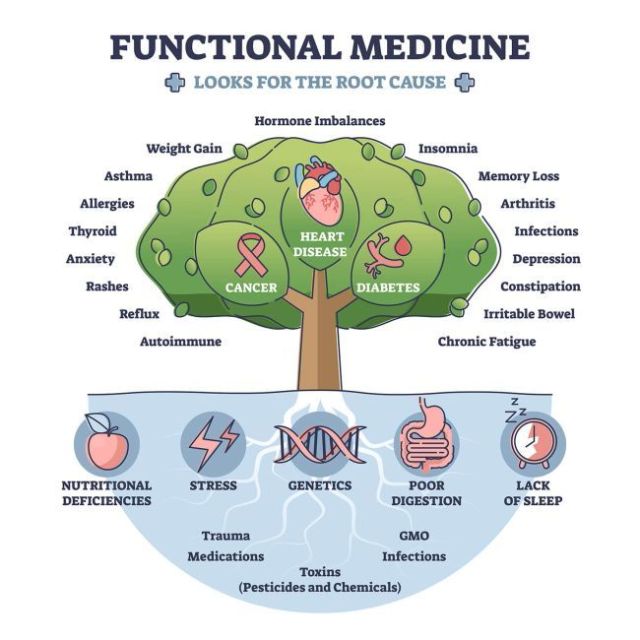
While conventional medicine excels at acute care and symptom management, functional medicine shines in its ability to address chronic conditions by treating the person as a whole and focusing on the root causes of dysfunction. It’s not about replacing one with the other but integrating the strengths of both to create a more comprehensive model of care.
Basic lifestyle interventions in functional medicine are foundational steps aimed at restoring balance and optimizing health by addressing the root causes of dysfunction. These interventions are tailored to the individual, recognizing their unique genetic, environmental, and lifestyle factors. Let me break this down for you:
Dietary Adjustments:
Removing processed foods, trans fats, and potential allergens from the diet is a cornerstone. This includes focusing on whole, nutrient-dense foods, such as vegetables, moderate amounts of fruit, and healthy fats like omega-3 fatty acids. Organic and locally grown foods are preferred when possible to minimize exposure to pesticides and toxins. Incorporating a balance of macronutrients (proteins, fats, and carbohydrates) and ensuring adequate fiber and water intake are also emphasized.
Gut Health Optimization:
The gut is central to overall health, with 80% of the immune system clustered around the intestinal tract. Supporting gut health involves using prebiotics, probiotics, and dietary changes to restore a healthy microbiome and reduce inflammation. This can significantly impact immune function and detoxification processes.
Stress Management:
Chronic stress can dysregulate the hypothalamic-pituitary-adrenal (HPA) axis, leading to systemic inflammation and metabolic dysfunction. Techniques such as mindfulness, meditation, or other stress-reduction practices are encouraged to promote resilience and balance.
Physical Activity:
Exercise is tailored to the individual’s physical condition, focusing on moderate, consistent movement to support cardiovascular health, mitochondrial function, and overall vitality.
Toxin Reduction:
Eliminating toxic exposures from the environment, such as household pesticides, herbicides, and harmful cleaning products, is another key step. This reduces the burden on the body’s detoxification systems.
Adequate Rest and Recovery:
Prioritizing quality sleep and ensuring sufficient rest is critical for cellular repair, immune function, and overall well-being.
Patient Education and Support:
Functional medicine emphasizes patient-centered care, where individuals are educated about how their daily choices impact their health. This empowers them to take an active role in their wellness journey. Support is provided to help integrate these changes without overwhelming the individual.
These interventions are not about simply managing symptoms but rather about creating a foundation for long-term health by addressing the underlying causes of dysfunction. They are dynamic and adaptable, reflecting the unique needs of each person.
These three terms often get used together, but they mean different things along the spectrum from normal aging to Alzheimer’s disease. Here’s a clear breakdown:
SCI (Subjective Cognitive Impairment)
What it means:
A person notices problems with memory or thinking, but when tested, their scores are still in the normal range for their age.
Examples:
Misplacing things more often, feeling like names or words are harder to recall, needing more effort to concentrate.
Testing:
No objective evidence of impairment on cognitive testing.
Daily life:
No impact on independence.
Important note:
SCI can be a “warning stage,” as some people with SCI later develop MCI or dementia, but not everyone does.
MCI (Mild Cognitive Impairment)
What it means:
A step beyond SCI. There is measurable evidence of memory or thinking problems on testing, greater than expected for normal aging.
Examples:
Forgetting important appointments, repeating questions, taking longer to make decisions, trouble following conversations.
Testing:
Cognitive tests show mild deficits, usually in memory, attention, or language.
Daily life:
Person remains independent in everyday activities (cooking, finances, self-care), though tasks may take longer or need compensatory strategies (notes, reminders).
Progression:
About 10–15% of people with MCI progress to Alzheimer’s each year, though some remain stable or even improve.
Mild Alzheimer’s Disease (Early Dementia Stage)
What it means:
Memory and thinking problems are significant enough to interfere with daily life and independence.
Examples:
Frequently forgetting recent events, difficulty managing finances or medications, repeating the same stories, getting lost in familiar places, personality or mood changes.
Testing:
Clear evidence of impairment across multiple cognitive domains.
Daily life:
Independence starts to be compromised. The person may still live at home but often needs help with complex tasks (bill paying, driving, cooking).
Medical diagnosis:
At this stage, doctors can confidently diagnose Alzheimer’s dementia (mild stage).
THE
BOTTOM LINE:
SCI: "I feel my memory is slipping" — but tests are normal, and daily function is fine.
MCI: "My memory is measurably worse than normal aging" — but daily independence is intact.
Mild Alzheimer's: "My memory/thinking problems are interfering with daily life" — dementia is present.
In short, we learned that we don't want to wait until MCI or dementia. We want to treat at the prevention and SCI stages if we can. If someone is already in the MCI or dementia stage, following the protocol within the family’s wishes, is a compassionate choice for getting the best chance at positive outcomes seen so far. Generally, the more effort one puts into closely the protocol and the more support from family, coaches and practitioners, the better the results. Here is a summary of Dr. Dale Bredesen's experience so far:
People who have no cognitive impairment, truly no symptoms, and started PreCODE have not gone on to dementia. There has not been one documented case so far.
And virtually all people who were just experiencing subjective cognitive decline and started ReCODE, if they were doing the basics to address their root causes, like infections and toxins, all improved and stay improved.
People already experiencing mild cognitive decline have a more difficult time regaining lost ground. Drs. Ann Hathaway and Deborah Gordon co-authored a 2022 study on 25 patients with mild cognitive impairment and early Alzheimer's disease. After nine months of implementing the Bredeson Protocol (TM), 84% of the trial patients' cognition improved, with some having their cognitive scores increase from the dementia range to normal. Some improved a lot, some a little, but as a group, the marked improvement was not as significant as for those following the protocol with SCI.
And for those who started the protocol for someone already with dementia, he has seen fair results. Some with MoCA scores of zero become continent again. Others can recognize their families again. But those with dementia don't come back to perfect.
Training your body to smoothly move in and out of ketosis can be a powerful way to lower your risk of diabetes and achieve a healthy weight. The key is a plan tailored to you—with the right macronutrient balance, safe fasting windows, nourishing foods, quality sleep, movement, and stress management.
Because everyone’s needs are different, we recommend our one-on-one nutrition and lifestyle coaching package. You’ll get a personalized roadmap and expert support every step of the way to help you reach your goals safely and effectively.
If you’re 35 or older and ready to put a little time back into yourself, our monthly group meet-ups are here for you. In a relaxed, supportive space, you’ll discover simple ways to feel healthier, get moving again, and boost your energy. It’s especially great if you’re balancing kids, parents, and a career—and just want an easy, uplifting way to look and feel your best.
Whether you’ve been recently diagnosed with dementia, care for someone who has, or carry a higher genetic risk, you don’t have to face it alone. Our monthly gatherings combine expert guidance from a clinical pharmacist with an easy, step-by-step plan focused on nutrition, lifestyle, and brain health.
This welcoming group is especially valuable for caregivers—who face higher stress and a greater risk of cognitive decline themselves—and for those with APOE4 genetics who want to take action now. Together, you’ll learn the latest science-based strategies to protect your brain, lower your risk, and stay on the path to long-term wellness.
Functional Pharmacy
BODY, MIND, AND SOUL
Vestal, New York 13850


Join the List for Exclusive Event Invites
Your privacy is respected. Your email is never shared. Unsubscribe anytime.
The content on this website is for educational purposes only and is not a substitute for professional medical advice. Always consult your healthcare provider before making health decisions.
2026 Functional Pharmacy LLC. All rights reserved. Artwork by Pasha.